
Inhalation Toxicity Poster (SOT-2026)
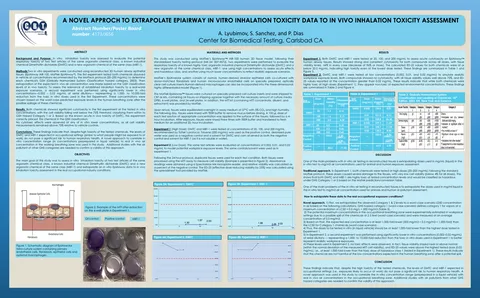
A NOVEL APPROCH TO EXTRAPOLATE EPIAIRWAY IN VITRO INHALATION TOXICITY DATA TO IN VIVO INHALATION TOXICITY ASSESSMENT
Center for Biomedical Testing, Carlsbad CA
Abstract Number/Poster Board number: 4173/J656
Abstract
Background and Purpose: In vitro inhalation toxicity was assessed to evaluate the potential respiratory toxicity of two test articles of the same organotin chemical class, a known industrial chemical Dimethyltin dichloride (DMTC) and a new organotin chemical of the same class (MBT-1).
Methods: Two in vitro experiments were conducted using reconstructed 3D human airway epithelial tissues (EpiAirway AIR-100, MatTek EpiAirway™). The first experiment tested both chemicals dissolved in vehicle at concentrations recommended by the MatTeck protocol (20–200 mg/mL) to determine each chemical's GSH (Globally Harmonized System Classification hazard category, 2003). Then extrapolation of the expected in vivo air concentration was made based on the GSH classification levels of in vivo toxicity. To assess the relevance of established inhalation toxicity to a real-world exposure scenarios, a second experiment was performed using significantly lower in vitro concentrations—0.002 – 0.02 mg/mL at serial dilutions— representing a 1,000- to 10,000-fold reduction from the toxic in vitro doses used in the first Experiment. These concentrations were chosen based on the worst-case predicted exposure levels in the human breathing zone after the possible spillage of these chemicals.
Results: Both chemicals showed significant cytotoxicity in the first experiment at the tested in vitro concentrations, with the cell viability falling well below the 75% threshold, classifying them within to GSH Hazard Category 1 or 2. Based on the known acute in vivo toxicity of DMTC, this experiment correctly placed this chemical in the GSH classification. No cytotoxic effects were observed at any of in vitro lower concentrations, as all cell viability measurements remained above 75% relative to vehicle controls.
Conclusions: These findings indicate that, despite high toxicity of the tested chemicals, the levels of DMTC and MBT-1 expected in occupational settings (similar to what people might be exposed to at work) do not pose a significant risk to human respiratory health. A novel approach to correlate in vitro concentration range (in concentrations preprepared in liquid vehicle) to real in vivo air concentration in the working breathing zone was used in this study. Additional studies with the air pollutant of other GHS categories are needed to confirm a validity of this approach.